The Smart Founder’s Guide to Delegating Work to AI Agents
The Smart Founder’s Guide to Delegating Work to AI Agents

Vishal Singh
Co-Founder

Delegating work to AI agents is not about handing over random tasks and hoping for the best. It is about building a clear operating system where the human stays accountable, and the AI agent handles well-defined parts of the work.
The best way to think about AI delegation is this: an AI agent is fast, tireless, and capable, but it is also very literal. It will follow what you specify, not what you silently assume. That means delegation to AI requires even more clarity than delegation to a human assistant or teammate.
Good AI delegation starts with three questions: What should I delegate? How should I break it down? And how much freedom should the agent have?
Start by Deciding What to Delegate
Not every task belongs with an AI agent. Some work requires your judgment, taste, relationships, or final accountability. But many tasks can be safely delegated, especially when they are repetitive, teachable, time-consuming, or clearly structured.
A useful rule is to delegate work that is outside your “zone of genius.” This includes tasks that drain your time but do not need your unique decision-making ability. For example, AI agents are great at summarizing research, drafting first versions, organizing information, comparing options, checking documents, creating outlines, and preparing reports.
However, you should avoid delegating final judgment too early. Instead of asking an agent to “make the decision,” ask it to prepare the analysis, options, risks, and recommendation so you can make the decision faster.
Break Big Goals into Atomic Tasks
Most AI delegation fails because the task is too vague. “Improve our marketing” is not a task. “Create a 900-word blog draft for SaaS founders on AI onboarding, using this outline and matching this tone” is much better.
Before giving work to an AI agent, break it into atomic tasks. An atomic task has one clear output, one format, and clear acceptance criteria. The agent should know exactly what “done well” means.
For example, instead of saying:
“Research our competitors.”
Say:
“Create a table of five competitors, including their positioning, pricing model, top three features, and one notable weakness. Use only the sources provided. Return the result in markdown.”
That level of clarity reduces confusion and makes the output easier to review.
Michael Hyatt's Delegation Levels
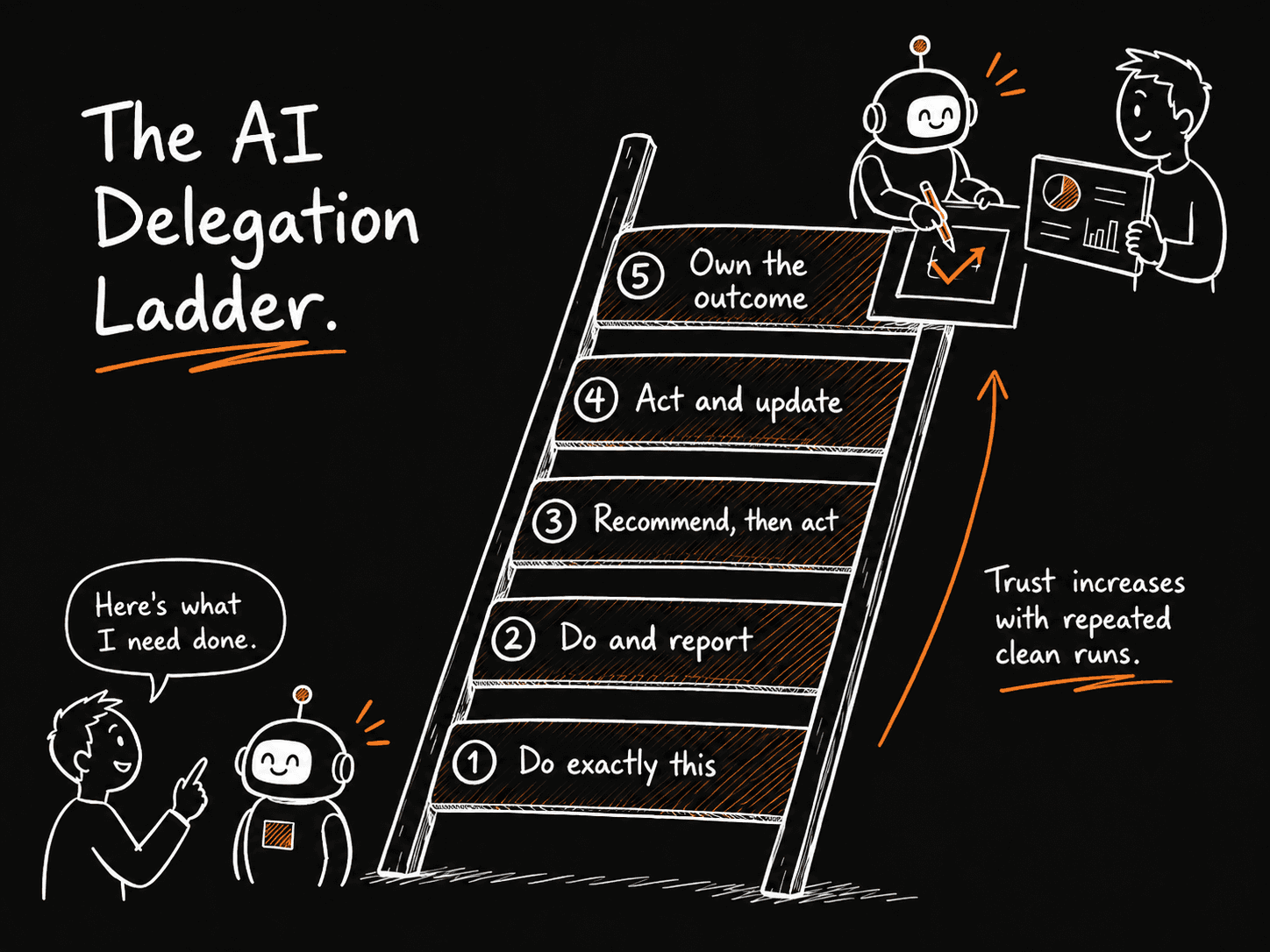
Michael Hyatt’s delegation framework is useful because it shows that delegation is not one-size-fits-all. You can give different levels of freedom depending on the task, risk, and trust level.
At Level 1, the agent does exactly what you tell it. This is best for new or high-stakes tasks.
At Level 2, the agent completes the task and reports what it did. This works well for low-risk recurring work.
At Level 3, the agent recommends a plan before acting. This is ideal for strategy, writing, research, or anything where you want to approve the direction first.
At Level 4, the agent acts independently and updates you at milestones. This is useful for trusted workflows.
At Level 5, the agent owns the outcome within clear guardrails. This should only be used after the process has been tested many times.
The safest approach is simple: start at Level 1 or 2, then increase autonomy only after the agent has repeatedly produced reliable work.
Give AI Agents a C.L.E.A.R. Brief
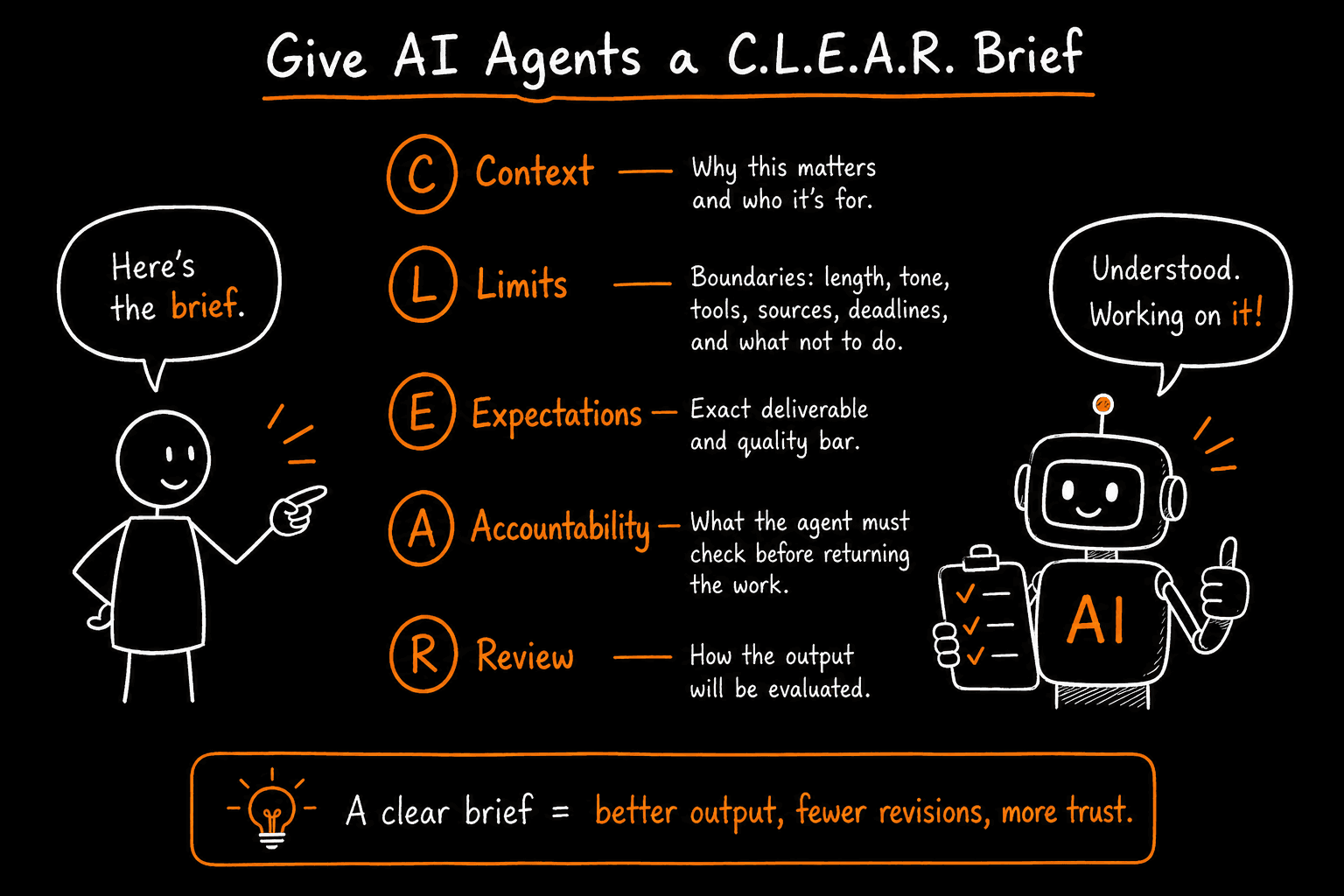
A strong brief is the heart of good delegation. Athena’s C.L.E.A.R. model works especially well for AI agents.
Context tells the agent why the task matters and who the output is for.
Limits define the boundaries, such as length, tone, tools, sources, deadlines, and what not to do.
Expectations describe the exact deliverable and quality bar.
Accountability tells the agent what it must check before returning the work.
Review explains how the output will be evaluated.
A weak prompt says:
“Help me with customer research.”
A better prompt says:
“Review these 25 customer feedback notes and create a markdown table with three columns: recurring pain point, example customer quote, and suggested next action. Group similar complaints together, avoid adding opinions not supported by the notes, and end with the top three issues the product team should investigate first.”
The second version gives the agent enough structure to produce something usable.
Choose the Right Agent Pattern
Sometimes one AI agent is enough. In fact, you should usually start with one agent before creating a complicated multi-agent workflow.
For simple work, use a single-agent workflow. For example, one agent can draft an article, summarize a document, or create a checklist.
For sequential work, use prompt chaining. One agent researches, then another drafts, then another edits.
For work with different categories, use routing. For example, customer requests can be routed to billing, technical support, or sales agents.
For larger projects, use an orchestrator-worker pattern. A manager agent breaks the project into pieces, assigns them to specialist agents, and combines the results.
For high-quality output, use an evaluator-optimizer pattern. One agent creates the work, and another reviews it against clear criteria.
The key is not to make the system fancy. The key is to make the work clear.
Keep the Human Accountable
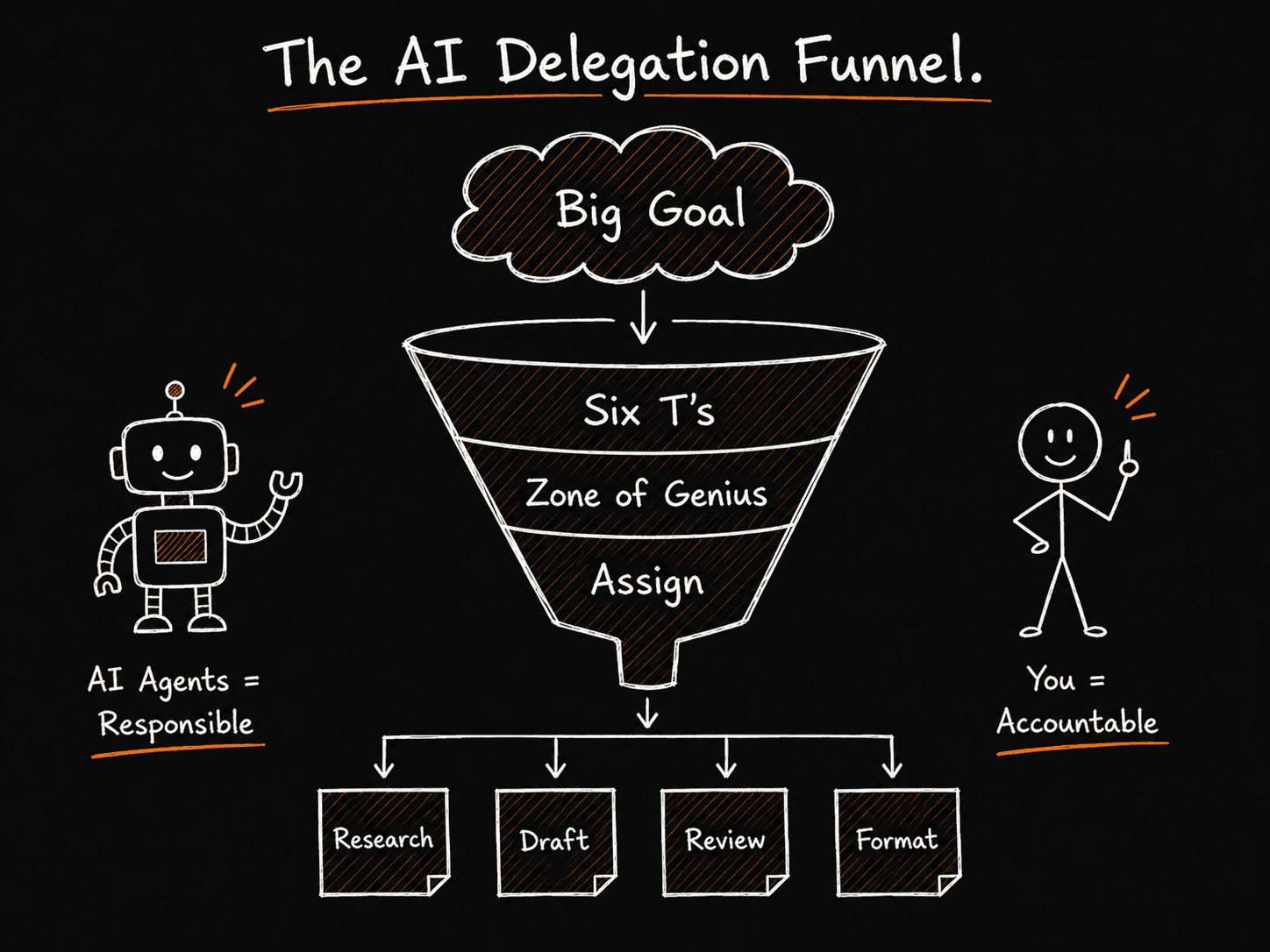
AI agents can be responsible for tasks, but the human remains accountable for outcomes. This is where the RACI model is helpful.
RACI stands for Responsible, Accountable, Consulted, and Informed.
Responsible means the person or agent doing the work. In an AI workflow, the AI agent may be responsible for drafting, researching, summarizing, formatting, or checking the output.
Accountable means the person who owns the final result. This should usually be the human. You approve the work, decide whether it is good enough, and take responsibility for how it is used.
Consulted means the people or sources whose input is needed before the work is complete. This could be a subject-matter expert, a manager, a customer-facing teammate, or another reviewer agent.
Informed means the people who need to know the result but do not need to approve every step. This could be your team, client, manager, or stakeholders.
This distinction matters. AI can draft the email, but you approve the message. AI can analyze the data, but you decide what action to take. AI can recommend next steps, but you own the consequences.
Add Review, Guardrails, and Feedback
Delegation is not “set it and forget it.” Every AI workflow needs a review layer.
For low-risk tasks, the review can be a simple checklist. For important tasks, use a second agent to critique the first agent’s output. For high-stakes work, keep a human checkpoint before anything is published, sent, or acted on.
Also, treat every mistake as feedback for the system. If the agent misunderstood the task, improve the brief. If the output was too broad, tighten the scope. If the quality was inconsistent, add examples and acceptance criteria.
Over time, your prompts, templates, checklists, and SOPs become a reusable delegation system.
What Not to Delegate to AI Agents
You should be careful with tasks that require sensitive judgment, emotional nuance, confidential decision-making, legal or financial accountability, hiring decisions, or relationship management.
AI agents can support these areas, but they should not fully own them without oversight.
For example, an AI agent can summarize a legal document, but a qualified professional should review the interpretation. An AI agent can draft a difficult email, but you should approve the tone before sending. An AI agent can rank candidates based on stated criteria, but humans should make the final hiring decision.
The best use of AI is not replacing judgment. It is preparing better inputs for judgment.
The Simple Operating System for AI Delegation
Here is a practical workflow:
First, decide whether the task should be delegated.
Second, break it into atomic subtasks.
Third, define the output and acceptance criteria.
Fourth, choose the right autonomy level.
Fifth, write a CLEAR brief.
Sixth, decide whether one agent is enough or multiple agents are needed.
Seventh, add review and guardrails.
Eighth, improve the process after every run.
This is how AI delegation becomes reliable.
You do not simply ask better prompts.
You build better systems.
Delegating work to AI agents is not about handing over random tasks and hoping for the best. It is about building a clear operating system where the human stays accountable, and the AI agent handles well-defined parts of the work.
The best way to think about AI delegation is this: an AI agent is fast, tireless, and capable, but it is also very literal. It will follow what you specify, not what you silently assume. That means delegation to AI requires even more clarity than delegation to a human assistant or teammate.
Good AI delegation starts with three questions: What should I delegate? How should I break it down? And how much freedom should the agent have?
Start by Deciding What to Delegate
Not every task belongs with an AI agent. Some work requires your judgment, taste, relationships, or final accountability. But many tasks can be safely delegated, especially when they are repetitive, teachable, time-consuming, or clearly structured.
A useful rule is to delegate work that is outside your “zone of genius.” This includes tasks that drain your time but do not need your unique decision-making ability. For example, AI agents are great at summarizing research, drafting first versions, organizing information, comparing options, checking documents, creating outlines, and preparing reports.
However, you should avoid delegating final judgment too early. Instead of asking an agent to “make the decision,” ask it to prepare the analysis, options, risks, and recommendation so you can make the decision faster.
Break Big Goals into Atomic Tasks
Most AI delegation fails because the task is too vague. “Improve our marketing” is not a task. “Create a 900-word blog draft for SaaS founders on AI onboarding, using this outline and matching this tone” is much better.
Before giving work to an AI agent, break it into atomic tasks. An atomic task has one clear output, one format, and clear acceptance criteria. The agent should know exactly what “done well” means.
For example, instead of saying:
“Research our competitors.”
Say:
“Create a table of five competitors, including their positioning, pricing model, top three features, and one notable weakness. Use only the sources provided. Return the result in markdown.”
That level of clarity reduces confusion and makes the output easier to review.
Michael Hyatt's Delegation Levels
Michael Hyatt’s delegation framework is useful because it shows that delegation is not one-size-fits-all. You can give different levels of freedom depending on the task, risk, and trust level.
At Level 1, the agent does exactly what you tell it. This is best for new or high-stakes tasks.
At Level 2, the agent completes the task and reports what it did. This works well for low-risk recurring work.
At Level 3, the agent recommends a plan before acting. This is ideal for strategy, writing, research, or anything where you want to approve the direction first.
At Level 4, the agent acts independently and updates you at milestones. This is useful for trusted workflows.
At Level 5, the agent owns the outcome within clear guardrails. This should only be used after the process has been tested many times.
The safest approach is simple: start at Level 1 or 2, then increase autonomy only after the agent has repeatedly produced reliable work.
Give AI Agents a C.L.E.A.R. Brief
A strong brief is the heart of good delegation. Athena’s C.L.E.A.R. model works especially well for AI agents.
Context tells the agent why the task matters and who the output is for.
Limits define the boundaries, such as length, tone, tools, sources, deadlines, and what not to do.
Expectations describe the exact deliverable and quality bar.
Accountability tells the agent what it must check before returning the work.
Review explains how the output will be evaluated.
A weak prompt says:
“Help me with customer research.”
A better prompt says:
“Review these 25 customer feedback notes and create a markdown table with three columns: recurring pain point, example customer quote, and suggested next action. Group similar complaints together, avoid adding opinions not supported by the notes, and end with the top three issues the product team should investigate first.”
The second version gives the agent enough structure to produce something usable.
Choose the Right Agent Pattern
Sometimes one AI agent is enough. In fact, you should usually start with one agent before creating a complicated multi-agent workflow.
For simple work, use a single-agent workflow. For example, one agent can draft an article, summarize a document, or create a checklist.
For sequential work, use prompt chaining. One agent researches, then another drafts, then another edits.
For work with different categories, use routing. For example, customer requests can be routed to billing, technical support, or sales agents.
For larger projects, use an orchestrator-worker pattern. A manager agent breaks the project into pieces, assigns them to specialist agents, and combines the results.
For high-quality output, use an evaluator-optimizer pattern. One agent creates the work, and another reviews it against clear criteria.
The key is not to make the system fancy. The key is to make the work clear.
Keep the Human Accountable
AI agents can be responsible for tasks, but the human remains accountable for outcomes. This is where the RACI model is helpful.
RACI stands for Responsible, Accountable, Consulted, and Informed.
Responsible means the person or agent doing the work. In an AI workflow, the AI agent may be responsible for drafting, researching, summarizing, formatting, or checking the output.
Accountable means the person who owns the final result. This should usually be the human. You approve the work, decide whether it is good enough, and take responsibility for how it is used.
Consulted means the people or sources whose input is needed before the work is complete. This could be a subject-matter expert, a manager, a customer-facing teammate, or another reviewer agent.
Informed means the people who need to know the result but do not need to approve every step. This could be your team, client, manager, or stakeholders.
This distinction matters. AI can draft the email, but you approve the message. AI can analyze the data, but you decide what action to take. AI can recommend next steps, but you own the consequences.
Add Review, Guardrails, and Feedback
Delegation is not “set it and forget it.” Every AI workflow needs a review layer.
For low-risk tasks, the review can be a simple checklist. For important tasks, use a second agent to critique the first agent’s output. For high-stakes work, keep a human checkpoint before anything is published, sent, or acted on.
Also, treat every mistake as feedback for the system. If the agent misunderstood the task, improve the brief. If the output was too broad, tighten the scope. If the quality was inconsistent, add examples and acceptance criteria.
Over time, your prompts, templates, checklists, and SOPs become a reusable delegation system.
What Not to Delegate to AI Agents
You should be careful with tasks that require sensitive judgment, emotional nuance, confidential decision-making, legal or financial accountability, hiring decisions, or relationship management.
AI agents can support these areas, but they should not fully own them without oversight.
For example, an AI agent can summarize a legal document, but a qualified professional should review the interpretation. An AI agent can draft a difficult email, but you should approve the tone before sending. An AI agent can rank candidates based on stated criteria, but humans should make the final hiring decision.
The best use of AI is not replacing judgment. It is preparing better inputs for judgment.
The Simple Operating System for AI Delegation
Here is a practical workflow:
First, decide whether the task should be delegated.
Second, break it into atomic subtasks.
Third, define the output and acceptance criteria.
Fourth, choose the right autonomy level.
Fifth, write a CLEAR brief.
Sixth, decide whether one agent is enough or multiple agents are needed.
Seventh, add review and guardrails.
Eighth, improve the process after every run.
This is how AI delegation becomes reliable.
You do not simply ask better prompts.
You build better systems.