Building for the Sake of It
Building for the Sake of It

Vishal Singh
Co-Founder
Most people assume building starts with a goal.
Money.
Status.
Users.
Growth.
Funding.
Some neat success story that can be explained in one line.
But the purest form of building starts much earlier than all of that.
It starts when you cannot help yourself.
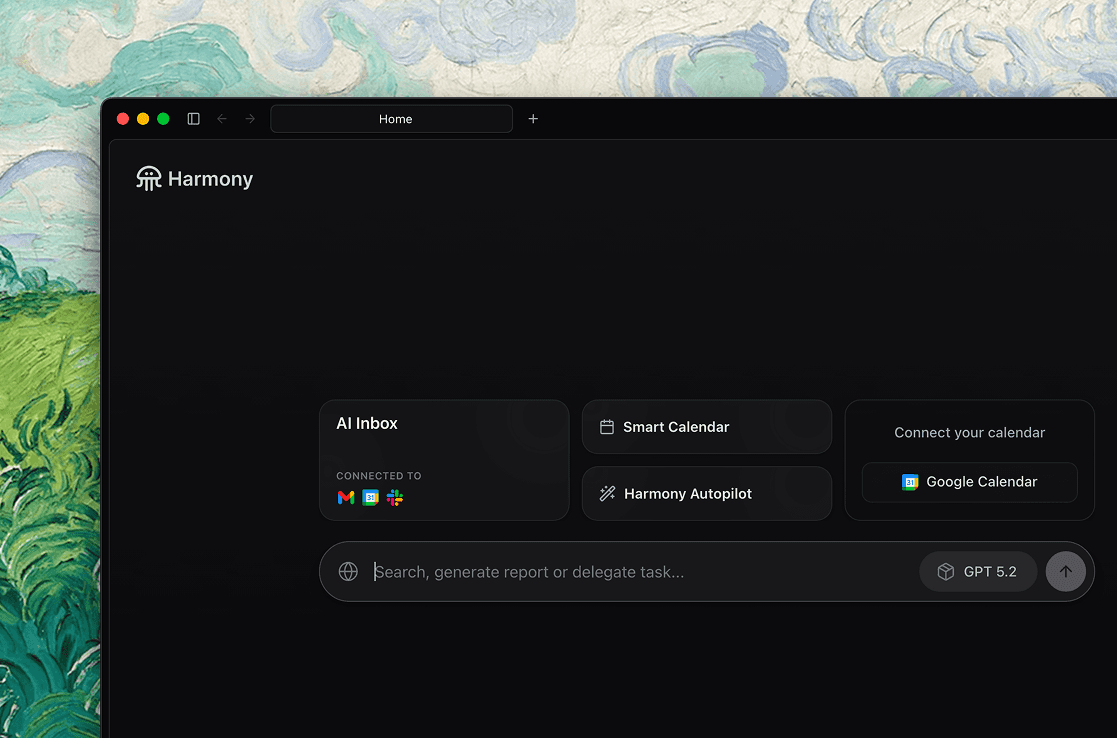
That is the spirit behind Harmony.
Craft as an Expression of self
Harmony was not born out of a market map or a trend report. It did not begin as an attempt to chase a category, force a startup, or dress up ambition in the language of productivity. It came from a much simpler place: the urge to make something that feels true.
The urge to reduce chaos. To shape noise into clarity. To take the scattered weight of modern work and turn it into something calm, useful, and elegant.
In that sense, Harmony is not just a product. It is an expression.
The Chaos of Modern Work
We live in a time where work is fractured across a hundred surfaces. Emails pile up. Slack threads multiply. Meetings create action items that disappear into memory. Tasks live everywhere and nowhere. Important details slip not because people are careless, but because the system itself is exhausting.
We are expected to think clearly while being surrounded by fragmentation.
Harmony is a response to that condition.
Not a loud one. Not a dramatic one. Just a deeply intentional one.
What Harmony Tries to Do
Harmony is built on the belief that work should feel more coherent. That the tools around us should not demand more attention than the work itself. That software should not merely store information, but help people stay aligned with what matters.
Harmony tries to do that quietly: by sorting signals, surfacing priorities, tracking follow-ups, organizing communication, and making sure things do not fall through the cracks.
The Builder’s Instinct
Underneath all of that functionality is something more human.
A builder’s instinct.
There is a certain kind of person who builds not because the world asked for permission, but because something inside them refuses to stay unmade. They see friction and want to smooth it. They see disorder and want to compose it. They see possibility and feel responsible for bringing it closer to reality.
Software as a Creative Act
That impulse is hard to explain to people who see products only as business vehicles. Because when building is real, it is almost personal.
It feels like writing, like music, like painting.
The medium may be software, but the act is still creative. The code, the workflows, the interface, the tiny decisions about how something should feel — all of it becomes a way of saying: this is how I think the world should work.
Harmony carries that energy.
A Better Rhythm for Work
Harmony is not trying to be software for the sake of software. It is trying to be a better rhythm for work. A better relationship with communication. A way to help people move through their days with less mental clutter and more intent.
That is why “Building for the sake of it” matters.
Building from Internal Necessity
Sometimes the strongest things are not built from external pressure. They are built from internal necessity. From conviction. From taste. From obsession. From the quiet refusal to accept that clunky, chaotic systems are the best we can do.
And ironically, that is often where the most meaningful products come from.
Not from asking, “What can I sell?”
But from asking, “What feels worth making?”
Not from chasing applause.
But from following a standard that lives inside you.
Who Harmony Is For?
Harmony belongs to that tradition.
It is for people who do serious work in a noisy world. For people who carry too much context in their heads. For people who are tired of being buried under communication instead of supported by it. For people who want technology to feel less like another burden and more like a reliable second mind.
More Than a Product
In the end, building for the sake of it is not about building without purpose.
It is about building from a deeper purpose.
The kind that comes before business models. Before pitch decks. Before categories and comparisons. The kind that begins with taste, truth, and the simple desire to make something beautiful and useful because you believe it should exist.
That is what Harmony is.
A product, yes.
A company, yes.
But first, an act of expression.
Most people assume building starts with a goal.
Money.
Status.
Users.
Growth.
Funding.
Some neat success story that can be explained in one line.
But the purest form of building starts much earlier than all of that.
It starts when you cannot help yourself.
That is the spirit behind Harmony.
Craft as an Expression of self
Harmony was not born out of a market map or a trend report. It did not begin as an attempt to chase a category, force a startup, or dress up ambition in the language of productivity. It came from a much simpler place: the urge to make something that feels true.
The urge to reduce chaos. To shape noise into clarity. To take the scattered weight of modern work and turn it into something calm, useful, and elegant.
In that sense, Harmony is not just a product. It is an expression.
The Chaos of Modern Work
We live in a time where work is fractured across a hundred surfaces. Emails pile up. Slack threads multiply. Meetings create action items that disappear into memory. Tasks live everywhere and nowhere. Important details slip not because people are careless, but because the system itself is exhausting.
We are expected to think clearly while being surrounded by fragmentation.
Harmony is a response to that condition.
Not a loud one. Not a dramatic one. Just a deeply intentional one.
What Harmony Tries to Do
Harmony is built on the belief that work should feel more coherent. That the tools around us should not demand more attention than the work itself. That software should not merely store information, but help people stay aligned with what matters.
Harmony tries to do that quietly: by sorting signals, surfacing priorities, tracking follow-ups, organizing communication, and making sure things do not fall through the cracks.
The Builder’s Instinct
Underneath all of that functionality is something more human.
A builder’s instinct.
There is a certain kind of person who builds not because the world asked for permission, but because something inside them refuses to stay unmade. They see friction and want to smooth it. They see disorder and want to compose it. They see possibility and feel responsible for bringing it closer to reality.
Software as a Creative Act
That impulse is hard to explain to people who see products only as business vehicles. Because when building is real, it is almost personal.
It feels like writing, like music, like painting.
The medium may be software, but the act is still creative. The code, the workflows, the interface, the tiny decisions about how something should feel — all of it becomes a way of saying: this is how I think the world should work.
Harmony carries that energy.
A Better Rhythm for Work
Harmony is not trying to be software for the sake of software. It is trying to be a better rhythm for work. A better relationship with communication. A way to help people move through their days with less mental clutter and more intent.
That is why “Building for the sake of it” matters.
Building from Internal Necessity
Sometimes the strongest things are not built from external pressure. They are built from internal necessity. From conviction. From taste. From obsession. From the quiet refusal to accept that clunky, chaotic systems are the best we can do.
And ironically, that is often where the most meaningful products come from.
Not from asking, “What can I sell?”
But from asking, “What feels worth making?”
Not from chasing applause.
But from following a standard that lives inside you.
Who Harmony Is For?
Harmony belongs to that tradition.
It is for people who do serious work in a noisy world. For people who carry too much context in their heads. For people who are tired of being buried under communication instead of supported by it. For people who want technology to feel less like another burden and more like a reliable second mind.
More Than a Product
In the end, building for the sake of it is not about building without purpose.
It is about building from a deeper purpose.
The kind that comes before business models. Before pitch decks. Before categories and comparisons. The kind that begins with taste, truth, and the simple desire to make something beautiful and useful because you believe it should exist.
That is what Harmony is.
A product, yes.
A company, yes.
But first, an act of expression.